 ultimate-guide
Hiring Electrician for Commercial Maintenance: 2026 Guide
Table of Contents
- Why Commercial Electrical Maintenance Is Not a DIY Job
- What a Commercial Maintenance Electrician Actually Does
- Licenses, Insurance, and Credentials to Verify Before You Hire
- Commercial Electrical Maintenance Checklist: What a Good Provider Covers
- OSHA Electrical Safety Standards for Commercial Properties
- Cost of Commercial Electrical Services: What Drives the Price
- How to Hire a Commercial Maintenance Electrician: Step-by-Step
- Vetting Checklist for Facility Managers
- Frequently Asked Questions
Last Updated: September 29, 2026
Why Commercial Electrical Maintenance Is Not a DIY Job
Commercial electrical maintenance is the scheduled inspection, testing, and repair of a building's electrical infrastructure, and it is not a do-it-yourself task because commercial systems run on 3-phase power at voltages and fault currents that can kill an untrained person. At Linder Electrical Contractors, we handle this work daily, and the difference between a residential outlet and a commercial distribution panel is not a matter of degree; it is a different discipline.
What a Commercial Maintenance Electrician Actually Does
A commercial maintenance electrician keeps a building's electrical distribution, lighting, and equipment circuits operating safely between major projects. The role splits into scheduled and reactive work, and the balance tells you how well a facility is run.
Daily Duties and Service Call Work
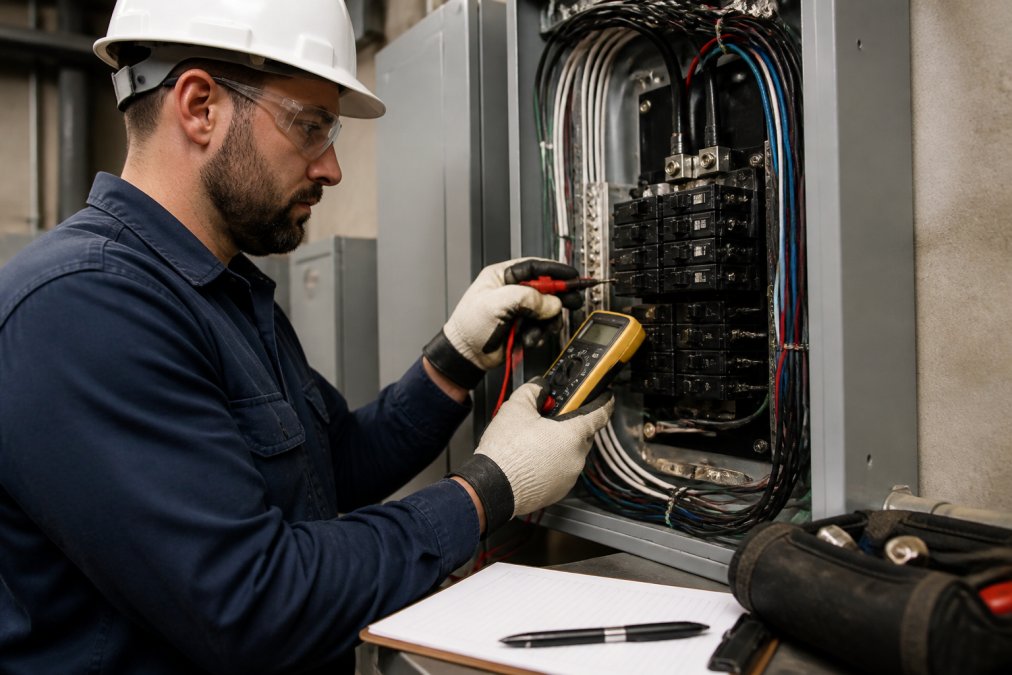
Daily duties include voltage testing, inspecting circuit breakers and panel upgrades, tracing faults, replacing failed components, and documenting everything in preventive maintenance logs. Service calls cover dead circuits, lighting retrofits, tripped breakers, and HVAC electrical components that fail mid-season.
Commercial vs. Industrial Maintenance Requirements
Commercial properties typically run 3-phase power for rooftop units, elevators, and tenant build-outs. Industrial systems add motor controls, variable frequency drives, and low voltage systems tied into process equipment. The skill sets overlap, but industrial work demands deeper familiarity with control logic and PLC-adjacent troubleshooting.
Licenses, Insurance, and Credentials to Verify Before You Hire
Verifying credentials takes about fifteen minutes and prevents most of the expensive problems that follow a bad hire. Every state sets its own licensing structure, so confirm the requirements where your building sits.
State Electrical License and Journeyman or Master Status
A journeyman electrician can perform most maintenance work under supervision or independently, depending on state rules. A master electrician holds the highest license tier and typically pulls permits and signs off on inspections. For commercial work, you want at least one master electrician attached to the contractor, even if a journeyman does the day-to-day repairs.
Compliance and Liability Insurance Requirements
General liability insurance covers property damage and injuries during the work; workers' compensation covers the electrician if they are hurt on your property. If a contractor cannot produce a current certificate of insurance naming your property management company, you are exposed to claims your own policy may not cover.
Commercial Electrical Maintenance Checklist: What a Good Provider Covers
A solid commercial electrical maintenance checklist covers inspections, testing, and documentation on a fixed schedule. If a provider cannot show you a written checklist before you sign, you are buying reactive repairs with a maintenance label.
A practical quarterly and annual checklist looks like this:
- Inspect and torque main distribution panel connections
- Test circuit breakers and ground fault protection
- Thermographic scan of panels and switchgear under load
- Verify emergency and exit lighting function
- Check motor controls and HVAC electrical components
- Review preventive maintenance logs against prior visits
- Update panel schedules and wiring diagrams
- Document code compliance issues with photos
| Task | Frequency | Why It Matters |
|---|---|---|
| Panel thermographic scan | Quarterly | Catches loose connections before failure |
| Breaker and GFCI testing | Quarterly | Confirms protection actually trips |
| Emergency lighting test | Monthly | Required for occupancy compliance |
| Full distribution inspection | Annually | Identifies aging infrastructure risks |
| Wiring diagram update | Annually | Speeds every future service call |
OSHA Electrical Safety Standards for Commercial Properties
OSHA electrical safety standards for commercial properties set the minimum bar for how energized work is planned, permitted, and performed. The rules apply to your contractors, but as the property owner or manager, you carry responsibility for the environment they work in, and that shows up in insurance claims, citations, and lawsuits after an incident.
The Standards That Actually Apply
Most commercial electrical maintenance work is governed by a handful of OSHA regulations and consensus standards:
- 29 CFR 1910 Subpart S (Electrical): Covers wiring design and protection, working clearances, guarding of live parts, and "qualified persons" requirements for work on or near exposed energized parts.
- 29 CFR 1910.147 (Lockout/Tagout): Requires a documented energy control procedure, training, and periodic inspection whenever servicing could release hazardous energy, for contractors and in-house staff alike.
- 29 CFR 1910.269 and 1910.333: Cover power generation, transmission, and distribution work practices plus general electrical work, including de-energizing before work unless it introduces increased hazards.
- NFPA 70E: Not an OSHA regulation, but cited by OSHA as recognized industry practice. Defines arc flash boundaries, incident energy analysis, PPE categories, and the energized work permit process.
- NFPA 70 (National Electrical Code): The installation standard adopted by most jurisdictions, governing panel labeling, grounding and bonding, working space, and equipment installation.
What Inspectors and Insurers Look For
After an incident, OSHA compliance officers and insurance adjusters tend to look at the same short list:
- Arc flash labeling: Panels and switchgear should carry labels showing available incident energy or required PPE category, based on an incident energy analysis or NFPA 70E tables.
- Working clearances: At least 36 inches of clear space in front of electrical equipment in most cases, depending on voltage and conditions. Storing boxes in front of a panel is one of the most common violations found during commercial inspections.
- Lockout/tagout documentation: A written energy control procedure, locks and tags at the point of use, and records of periodic inspections.
- PPE and training records: Evidence that anyone working on or near energized equipment is trained as a qualified person with access to PPE rated for the hazard.
- Energized work permits: For work that cannot be de-energized, a documented permit signed by an authorized individual, with the justification and hazard analysis attached.
Your Liability as the Property Owner or Manager
OSHA citations generally go to the employer, the electrical contractor, not the building owner. But that does not insulate you. Your exposure comes from three directions:
- Contractual indemnity and insurance requirements. If your service agreement does not require the contractor to carry general liability and workers' compensation insurance naming your entity, an injury on your property can land on your policy.
- Premises liability. If a tenant, visitor, or contractor is injured by an electrical hazard you knew or should have known about, a missing panel cover, an unlabeled disconnect, a blocked egress, the claim runs against the property owner.
- Insurance underwriting. Commercial property insurers increasingly ask for evidence of a preventive maintenance program, arc flash labeling, and documented contractor qualifications. Gaps can affect coverage or premiums after a loss.
Documentation to Keep on File
- Current certificate of insurance from every electrical contractor, naming your entity as additional insured where required
- Copy of the contractor's state electrical license and the master electrician's license number
- Written lockout/tagout procedures for equipment on your property
- Arc flash labels or the incident energy analysis that produced them
- Records of preventive maintenance visits, including thermographic scans and torque checks
- Permits and inspection sign-offs for any panel or circuit work
A simple binder, physical or digital, with these items turns a post-incident investigation from a liability crisis into a routine document request. The OSHA electrical standards overview outlines the underlying obligations, and your insurance broker can confirm exactly which documents your carrier expects to see.
Cost of Commercial Electrical Services: What Drives the Price
The cost of commercial electrical services depends on scope, the building's age and wiring condition, access difficulty, and whether work happens during business hours or after them. There is no single rate card, and any contractor who quotes one without seeing the site is guessing. Understand the cost structure so you can compare bids apples-to-apples instead of chasing the lowest hourly number.
How Commercial Electrical Work Is Priced
Commercial maintenance is billed one of three ways:
- Time and materials (T&M): Hourly labor plus a parts markup. Best for diagnostics and small repairs where scope is unknown. Ask for the hourly rate, after-hours multiplier, parts markup, and trip charge in writing.
- Flat-rate pricing: A fixed price per task (for example, replacing a 20-amp breaker or testing a panel). Best for predictable, repeatable maintenance because it shifts the risk of a longer-than-expected job onto the contractor.
- Preventive maintenance agreement: A fixed monthly or quarterly fee covering scheduled inspections, testing, and documentation, usually with a discounted labor rate for repairs the inspections uncover. Best for budget predictability.
What Actually Moves the Number
- Building age and wiring type: Older infrastructure hides problems behind walls, and aluminum branch wiring, cloth-insulated conductors, or unlabeled panels add diagnostic time before any repair begins.
- Access: High ceilings, occupied tenant spaces, and after-hours scheduling add labor. A repair that takes an hour at 10 a.m. in an empty suite can take three at 10 p.m. in a retail space.
- Permits and inspections: Required for panel upgrades, new circuits, and service changes. Permit fees and inspection scheduling are pass-through costs, and the labor to meet an inspector is real time.
- Emergency vs. scheduled: Emergency and after-hours calls carry premium rates, often a multiple of the standard hourly rate, plus a minimum call-out charge.
- Parts availability: Specialty breakers, obsolete switchgear components, and motor controls may need to be ordered, adding lead time and sometimes expedited shipping.
- Arc flash and PPE requirements: Work on or near energized equipment may require an energized work permit, an incident-energy analysis, and PPE rated for the available fault current, planning and gear a residential-style bid will not include.
Request a written estimate that separates labor, materials, permits, and contingency. A vague "time and materials" quote on a major job is a red flag, but so is a flat price quoted without a site visit.
In-House vs. Contracted Maintenance: A Cost-Benefit Look
This is the decision most facility managers face, and it rarely gets a straight answer. Here is the honest trade-off.
In-house staff make sense when:
- You operate several large buildings with enough call volume to keep a full-time electrician busy year-round.
- You need sub-hour response times on critical systems (data rooms, refrigeration, life safety).
- You have the management depth to supervise, train, and retain licensed electrical staff.
Contracted maintenance wins when:
- You manage a single property or small portfolio where a full-time electrician would sit idle between calls.
- You want to avoid the overhead of payroll taxes, benefits, a service vehicle, a fuel card, tool replacement, licensing renewals, and continuing education.
- You need licensed master-level expertise only intermittently, such as for permit work, arc flash studies, or switchgear upgrades.
What to Ask for in Every Estimate
- Labor hours broken out by task, not a single lump sum
- Hourly rate, after-hours multiplier, and trip charge stated separately
- Parts listed by description and quantity, with markup disclosed
- Permit and inspection fees as line items
- A stated contingency percentage for hidden conditions
- A written scope that names what is excluded
A bid you can compare line by line is worth more than a bid that is 10 percent cheaper but opaque.
How to Hire a Commercial Maintenance Electrician: Step-by-Step
Hiring a commercial maintenance electrician follows a predictable sequence, and skipping steps is how facility managers end up with unpermitted work and surprise invoices.
- Define the scope. List your buildings, panel types, known problem areas, and whether you need emergency coverage.
- Verify licensing. Confirm the master electrician's license is active with your state board.
- Request insurance certificates. General liability and workers' compensation, current and naming your entity.
- Ask for references from similar properties. Commercial experience matters more than years in business.
- Request a written estimate. Labor, materials, permits, and inspection fees itemized separately.
- Confirm permit handling. Ask who pulls permits and who meets the inspector.
- Set a maintenance schedule. Quarterly and annual visits with documented checklists.
- Agree on emergency terms. Response windows, after-hours rates, and who to call.
Vetting Checklist for Facility Managers
Use this checklist before signing anything. It takes one afternoon and saves months of headaches.
- License number verified with the state board
- Master electrician named on the license
- Certificate of insurance on file, current
- Workers' compensation coverage confirmed
- Three commercial references contacted
- Written estimate with itemized line items
- Permit responsibility stated in writing
- Maintenance checklist provided upfront
- Emergency response terms agreed
- No unresolved complaints with the state board
Frequently Asked Questions
What qualifications should I look for in a commercial maintenance electrician?
Verify a current state electrical license at the journeyman or master level, plus general liability and workers' compensation insurance. Ask for proof of OSHA 10 or 30 training, experience with 3-phase power and industrial electrical systems, and references from similar commercial properties. A provider that also handles permits and electrical inspections saves you from chasing the township and utility company yourself.
How often should commercial properties schedule electrical maintenance?
Most commercial buildings benefit from quarterly or semi-annual preventive maintenance, with annual infrared scans of panels and switchgear. High-traffic or industrial sites with heavy motor loads may need monthly service calls. A written commercial electrical maintenance checklist and preventive maintenance logs keep inspections, voltage testing, and breaker checks on schedule so small issues do not become emergency repairs.
What is the difference between commercial and residential electrical maintenance?
Commercial work involves 3-phase power, larger electrical distribution systems, motor controls, HVAC electrical components, and low voltage systems that rarely appear in homes. Commercial building codes and OSHA safety standards add inspection and documentation requirements. A residential electrician may lack the diagnostic equipment and licensing scope for panel upgrades, lighting retrofits, and service calls in a commercial facility.
What are the benefits of a long-term commercial electrical maintenance contract?
A maintenance contract locks in scheduled electrical inspections, priority on-call availability, and documented preventive maintenance programs. You get predictable budgeting on the cost of commercial electrical services, faster emergency repairs, and a provider who already knows your building's wiring diagrams and electrical infrastructure. It also creates a paper trail of electrical code compliance that protects you during liability claims or tenant disputes.