 Ultimate guide
Installing Level 2 Home EV Charger: A Complete Guide
Last Updated: October 23, 2026
Quick Summary
A level 2 home EV charger operates on a 240-volt circuit and delivers 25-30 miles of range per hour, making it the practical choice for most homeowners who want reliable overnight charging. Installation requires a dedicated circuit, professional electrical work, and a permit with local inspection to ensure code compliance and safety.
- Level 2 chargers deliver 25-30 miles of range per hour, compared to 2-5 miles per hour for Level 1.
- A 30-amp circuit delivers 7 kilowatts and charges most vehicles in 8-10 hours overnight.
- Installation requires a dedicated 240-volt circuit, proper wiring gauge, circuit breaker, and conduit from your electrical panel.
- Permits and inspections are required in most jurisdictions to ensure the installation meets electrical code.
- The entire installation process typically takes 2-4 weeks from assessment to final inspection approval.
Table of Contents
- Level 1 Versus Level 2 Home Charging: Understanding Your Options
- How Level 2 Charging Works and What It Delivers
- Home EV Charger Electrical Requirements You Need to Know
- Hardwired Versus Plug-in Level 2 Charger: Which Fits Your Home
- Level 2 EV Charger Installation Cost: Breaking Down Labor and Equipment
- EV Charger Installation Permit and Inspection Requirements
- Step-by-Step Installation Process and What to Expect
- Panel Upgrade and Load Calculation for Your Home
- Frequently Asked Questions
Level 1 Versus Level 2 Home Charging: Understanding Your Options
Charging an EV at home comes down to two levels. Level 1 charging uses a standard 120-volt household outlet and delivers roughly 2-5 miles of range per hour. Level 2 charging operates on a 240-volt circuit and delivers 25-30 miles per hour, making it the practical choice for most homeowners who want reliable overnight charging.
The real difference comes down to your panel's capacity and your driving patterns. Level 1 works if you drive fewer than 30 miles per day and charge overnight. Most commuters need Level 2. We help homeowners assess which option fits their actual usage, not just their budget.
Level 2 requires a dedicated 240-volt circuit and professional installation, either hardwired or via a NEMA 14-50 outlet. A licensed electrician evaluates your panel capacity, runs the wiring, and ensures code compliance. The planning pays off: charging becomes a reliable daily routine.
How Level 2 Charging Works and What It Delivers
A level 2 home EV charger converts 240-volt alternating current from your home's electrical service into power your vehicle's onboard charger can use. Your main panel supplies a dedicated circuit breaker, and heavy-gauge copper wiring (typically 6 or 8 gauge depending on amperage) runs to the charger, usually in your garage.
The charging speed depends on the amperage your circuit can safely deliver. A 30-amp circuit delivers roughly 7 kilowatts and charges most vehicles to full in 8-10 hours overnight. A 50-amp circuit delivers 11.5 kilowatts and can charge a depleted battery in 5-7 hours.
What makes Level 2 practical is consistency: plug in at night, and by morning your vehicle is charged, eliminating range anxiety for daily driving. The charger manages voltage and amperage automatically and includes safety features like ground fault protection, overcurrent detection, and thermal monitoring.
Level 2 charging speed and overnight charging time depend on the circuit amperage your installation supports.
| Circuit Amperage | Power Output | Charging Time |
|---|---|---|
| 30 amps | 7 kilowatts | 8-10 hours overnight |
| 50 amps | 11.5 kilowatts | 5-7 hours |
Home EV Charger Electrical Requirements You Need to Know
Installing a level 2 home EV charger requires your electrical system to meet specific standards. The National Electrical Code (NEC) governs residential installations, enforced locally through permits and inspections (Learn More About NFPA 70, National Electrical Code (NEC)).
Your panel must have available capacity. Most homes built in the last 20 years have 200-amp service, which provides sufficient headroom.
The dedicated circuit itself must be sized appropriately. A 30-amp charger requires a 40-amp circuit breaker and 8-gauge wiring. A 40-amp charger requires a 50-amp breaker and 6-gauge wiring. These are minimums set by code.
Wiring runs from your panel to the charger, typically through conduit. Runs over 50 feet may need heavier wire gauge to prevent voltage drop.
National Electrical Code requirements for EV charger installations provide the technical standards your installation must meet. We recommend reviewing Can My Panel Support an EV Charger? A Homeowner's Guide to assess your specific situation before moving forward.
Hardwired Versus Plug-in Level 2 Charger: Which Fits Your Home
The two installation approaches offer different trade-offs. A hardwired charger is permanently mounted and directly connected to the circuit, the most common residential choice. It's typically more affordable than plug-in options and delivers reliable, consistent charging with nothing to connect or disconnect.
A NEMA 14-50 outlet installation creates a receptacle similar to a heavy-duty RV outlet. You install a plug-in charger into this outlet, which gives you flexibility. If you upgrade your charger in the future, you can simply unplug the old one and plug in a new one without rewiring. You can also use the outlet for other 240-volt equipment if needed.
For most homeowners, hardwired makes sense: the charger stays for years, is weather-sealed, and always ready. Plug-in chargers appeal to those who anticipate moving or want maximum flexibility.
Installation differs slightly: hardwired means terminating the circuit at the charger's junction box, while a NEMA 14-50 outlet means installing and wiring the outlet box. Base your choice on long-term needs and whether flexibility is worth the extra cost.
Level 2 EV Charger Installation Cost: Breaking Down Labor and Equipment
Installation costs break into three parts: equipment (charger, breaker, wiring, conduit, materials), labor (design, installation, inspection coordination), and permit and inspection fees, which vary by jurisdiction.
The charger itself ranges widely depending on features. Basic hardwired models are more affordable than premium units with advanced features like load management or smartphone connectivity.
Wiring and conduit costs depend on distance from panel to charger: a 20-foot run costs far less than a 60-foot run to a detached garage.
Labor typically represents a significant portion of installation cost.
Permit and inspection fees are set by your local authority having jurisdiction (AHJ), either flat or based on project value, and ensure your installation meets code.
One important note: if your home requires a panel upgrade to support the charger, that's a separate major cost. Can I Add an EV Charger to a 100 Amp Panel? addresses this scenario specifically.
EV Charger Installation Permit and Inspection Requirements
Every level 2 home EV charger installation requires a permit in most jurisdictions. The process ensures your installation meets electrical code and won't create fire or shock hazards, protection for your home and family.
The permit application requires details about your installation: charger specifications, circuit amperage, wiring gauge, distance from panel, and charger location. Your electrician typically handles the permit paperwork.
Once installation is complete, a local inspector verifies the work meets code: proper wiring size, correct breakers, conduit, grounding, and secure connections. The inspection typically takes 30-60 minutes, and passing officially clears your installation.
A permitted, inspected installation means your charger meets safety standards, won't void your home insurance, and leaves a permit record proving the work was done properly. Electrical Permit Process for Homeowners: A Step-by-Step Guide walks through the full process.
At Linder Electrical Contractors, we handle all permit and inspection coordination. You don't chase down the township or utility company, we manage that entire process so you can focus on your home.
Step-by-Step Installation Process and What to Expect
The installation process follows a logical sequence, from planning through final inspection. Understanding each step helps you prepare and know what's happening in your home.
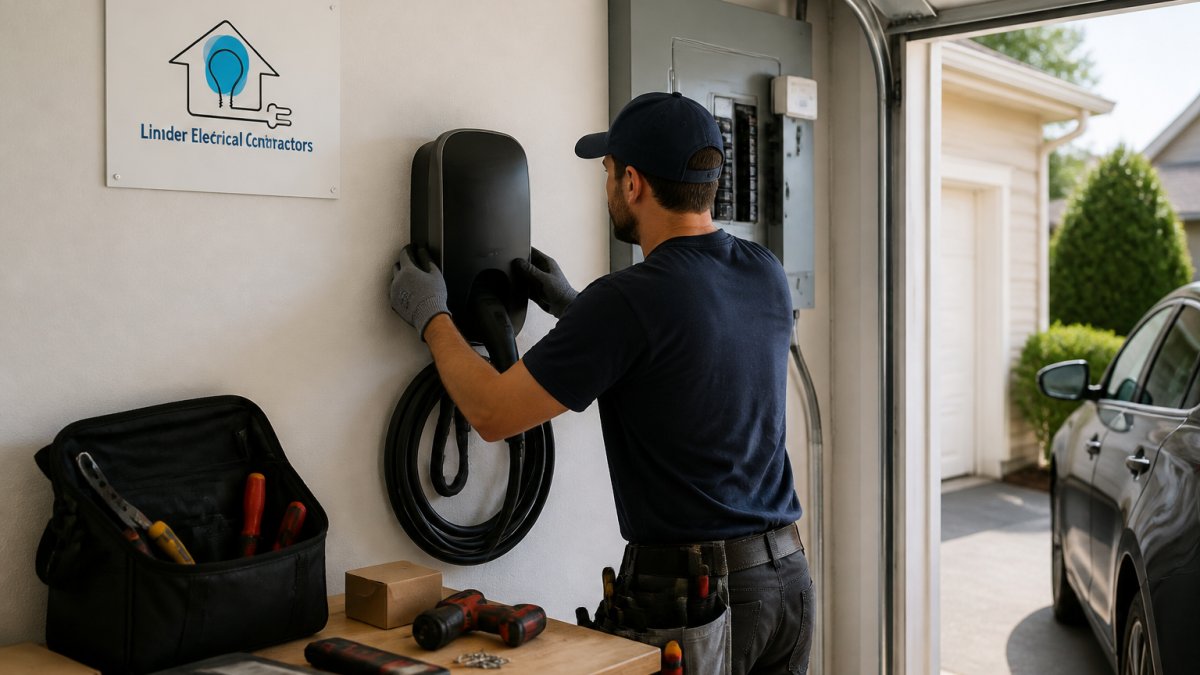
Step 1: Home Electrical Assessment and Load Calculation Your electrician evaluates your panel, calculates your home's total load, and determines whether it has capacity for a dedicated charger circuit.
Step 2: Design and Permit Application The electrician designs the circuit, determines wiring gauge and conduit size, and calculates the distance from panel to charger.
Step 3: Material Procurement Once the permit is approved, materials are ordered: the charger, circuit breaker, wiring, conduit, outlet boxes, and fasteners.
Step 5: Inspection and Final Approval Once installation is complete, the electrician notifies the AHJ for inspection. The inspector verifies all work meets code and safety standards.
Step 6: Charger Testing and Activation After inspection approval, the charger is tested to ensure it communicates properly with your vehicle and delivers power safely.
The entire process typically takes 2-4 weeks from initial assessment to final inspection approval, depending on permit processing times and material availability. We coordinate every step and keep you informed throughout.
Panel Upgrade and Load Calculation for Your Home
If your home's electrical panel lacks capacity for a dedicated charger circuit, a panel upgrade becomes necessary. Understanding this decision helps you plan properly.
Load Calculation Basics Your home's electrical load is the sum of all power your appliances and systems draw. Major loads include heating and cooling, water heating, cooking, and lighting.
If your home has 100-amp service and your current load is already 70-80 amps, adding a 30-40 amp charger circuit exceeds safe capacity.
When a Panel Upgrade is Necessary An electrician calculates your actual demand load using code-approved methods. They account for the size of your heating system, water heater, range, and other major appliances.
A panel upgrade involves replacing your main electrical service. The utility may need to upgrade the service line from the street to your home. Residential Electrical Service Upgrades: A Guide and Electrical Panel Replacement Cost 2026: Pricing Guide provide detailed guidance on this process.
Future-Proofing Your Home If you're planning a panel upgrade anyway, consider sizing it for future needs. A 200-amp panel provides capacity for a charger, potential solar installation, backup generator, or other future electrical projects.
We evaluate your long-term electrical needs and recommend a panel size that supports both your immediate charger installation and your future plans.
Installing a level 2 home EV charger is a manageable project when you understand what's involved and work with a licensed electrician who handles permits and inspections. Your home's electrical system, local code requirements, and your charging needs all factor into the plan. At Linder Electrical Contractors, we assess your specific situation, provide a clear estimate, manage all permits and inspections, and ensure your charger is installed safely and code-compliant.
Frequently Asked Questions
Can I install a Level 2 home EV charger myself?
No. Installing a Level 2 EV charger requires a licensed electrician and compliance with electrical code. The work involves high-voltage wiring, circuit breaker installation, and often panel upgrades, tasks that demand professional expertise and permitting. DIY attempts create fire and electrocution hazards and void your home's electrical warranty. Always hire a licensed contractor.
How much does it cost to install a Level 2 EV charger at home?
Installation cost depends on your home's electrical panel capacity, distance from the panel to the charger location, whether you need a panel upgrade, and local labor rates. Simple installations in homes with adequate capacity cost less than those requiring significant electrical work. Contact a licensed contractor for a free written estimate, pricing varies by your specific situation and local conditions.
Do I need a permit to install a home EV charger?
Yes. Most jurisdictions require a permit for Level 2 charger installation. Permits ensure the work meets electrical code and safety standards. A licensed electrician handles the permit application, inspection scheduling, and final sign-off. Installing without a permit creates liability, fails home inspections, and may void insurance coverage if an electrical fire occurs.
Does my electrical panel need an upgrade for a Level 2 EV charger?
Maybe. A professional electrical assessment determines whether your panel has sufficient capacity. Most modern homes with 200-amp service can accommodate a Level 2 charger, but older homes or those with high existing loads may require a panel upgrade. A licensed electrician performs a load calculation to identify your actual capacity and recommend the right solution.
How long does it take to install a Level 2 home EV charger?
A straightforward installation typically takes one to two days. If your panel needs upgrades, trenching is required, or significant wiring is necessary, the project extends to several days. Permit approval and inspection scheduling add additional calendar time. Your contractor provides a timeline after assessing your specific installation requirements.
What is the difference between a hardwired Level 2 charger and a plug-in model?
A hardwired charger is permanently connected to a dedicated circuit and cannot be unplugged, it's more efficient and faster. A plug-in charger uses a NEMA 14-50 outlet and can be disconnected, offering portability if you move. Hardwired is standard for home installations because it delivers consistent charging speed and eliminates outlet wear. Plug-in is useful if you want to move the charger or share the outlet for other high-power equipment.
What electrical upgrades might I need for a Level 2 charger?
You may need a new 240-volt dedicated circuit with appropriate amperage (typically 40-50 amps), a new circuit breaker, updated wiring and conduit, and possibly a panel upgrade if your service lacks capacity. Older homes may also require conduit installation and wall penetrations. A licensed electrician's assessment determines exactly what your home requires and whether a panel upgrade is necessary.