 blog
blog
Hiring an Electrician for Property Transaction Repairs
Table of Contents
- Why Electrical Repairs Matter in Property Transactions
- Finding and Comparing Qualified Electricians
- How to Verify an Electrician's License and Insurance
- Questions to Ask Before Hiring an Electrician
- Creating an Electrician Repair Estimate Checklist
- Understanding Permits, Inspections, and Documentation for Home Sales
- Managing Timeline and Responsibility During Property Transactions
- Frequently Asked Questions
Last Updated: October 16, 2026
Why Electrical Repairs Matter in Property Transactions
Electrical issues can derail a property sale fast. A home inspection reveals faulty wiring, outdated panels, or safety hazards, and suddenly you're deciding who fixes it and who pays.
The difference between a smooth transaction and a costly dispute often comes down to hiring electrician property transaction expertise early and understanding what documentation the lender and inspector require.
In a property transaction, electrical repairs protect your investment and keep the deal on track.
Finding and Comparing Qualified Electricians
When comparing electricians, focus on three things: experience with property transactions, responsiveness, and willingness to provide a detailed written estimate before starting.
Ask each electrician how many property transaction repairs they've handled, whether they've coordinated with home inspectors, and if they understand lender documentation requirements.
Get at least two or three written estimates. Compare not just price but what's included: materials, labor, permits, inspections, and guarantees.
How to Verify an Electrician's License and Insurance
Before you hire anyone to touch your electrical system, verify their credentials.
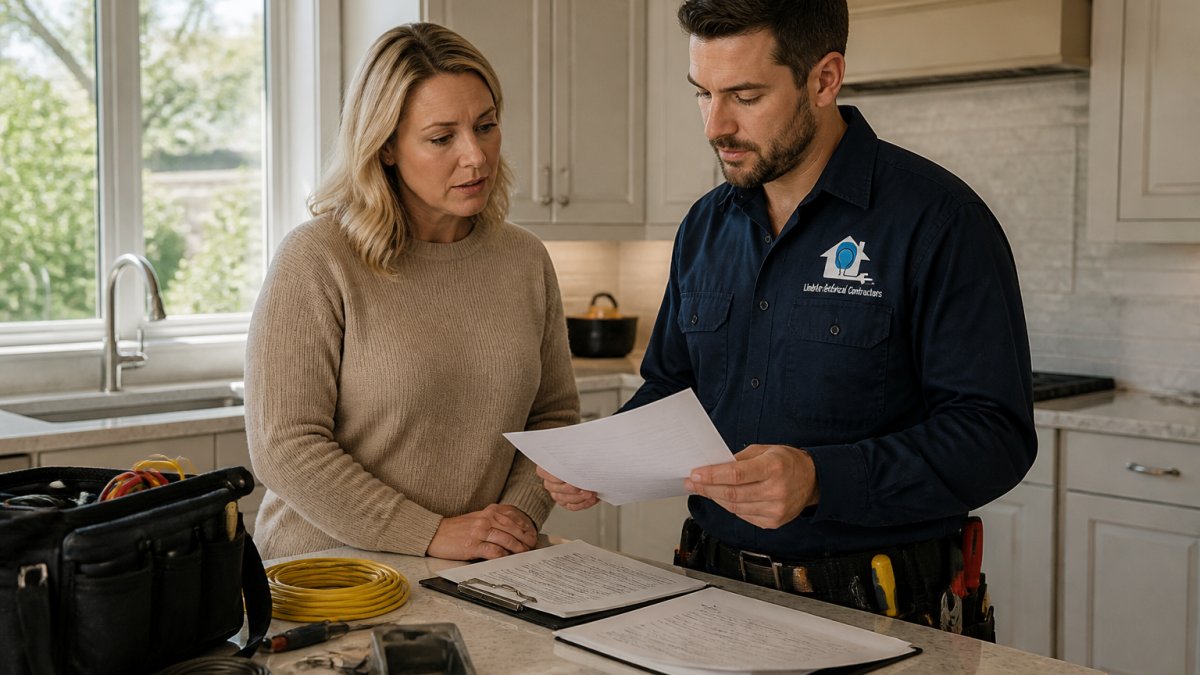
Check the contractor's license with your state or local licensing board. Most maintain searchable online databases.
Ask for proof of liability insurance and workers' compensation coverage, a current certificate, not a verbal confirmation.
Check for complaints or disciplinary history with the licensing board. Most maintain public records of violations, fines, or suspensions.
Questions to Ask Before Hiring an Electrician
Before you commit, ask these questions to gauge whether the electrician fits your hiring electrician property transaction needs:
-
How many property transaction repairs have you completed? This reveals whether they understand the demands of buying or selling with electrical issues.
-
Will you handle all permits and inspections, or is that my responsibility? You want the contractor to manage this, it ensures everything is done correctly.
-
What's your timeline? Confirm the electrician can start and finish within your closing schedule.
-
Do you provide a warranty?
-
Will you coordinate with the home inspector? If an inspector flagged the issue, the electrician should discuss findings and explain the repair plan.
-
What documentation will you provide when the work is complete? You'll need proof of permits, inspection sign-offs, and a detailed invoice for your records and the lender.
-
Are you available for emergency calls? Electrical problems don't follow business hours. Knowing you can reach someone quickly gives peace of mind.
-
How do you handle unexpected issues? Old homes reveal surprises. Ask how the contractor will communicate price changes and get approval before proceeding.
Creating an Electrician Repair Estimate Checklist
A detailed estimate is your roadmap, protecting you and the electrician by making expectations clear upfront. It should include:
| Item | What to Look For | Why It Matters |
|---|---|---|
| Scope of Work | Specific repairs listed (e.g., "Replace 60-amp panel with 200-amp panel") | Vague descriptions lead to disputes about what's included |
| Materials | Brand, quantity, and cost of parts and supplies | Helps you understand where money is going |
| Labor | Hourly rate or flat fee, estimated hours, and total labor cost | Prevents surprise charges for time |
| Permits | Cost of electrical permits and inspection fees | Ensures permits are factored into the budget |
| Timeline | Start date, expected completion date, and any dependencies | Critical for property closing deadlines |
| Warranty | Coverage period and what's included (labor, parts, or both) | Protects you after the work is done |
| Payment Terms | When deposits are due, payment schedule, and final payment terms | Clarifies financial expectations |
| Insurance & License | Contractor's license number and insurance policy numbers | Proof of credentials and protection |
Before signing, review the estimate with the electrician. Ask about any line items you don't understand, and get vague items clarified in writing. A good contractor appreciates the detail, it prevents misunderstandings later.
Understanding Permits, Inspections, and Documentation for Home Sales
This is where many property transactions stumble, and where a transaction-savvy electrician earns their fee. Most electrical work beyond a like-for-like fixture swap requires a permit from the local building or electrical department. The permit proves the work was done to code and inspected by an authority having jurisdiction (AHJ), the city, county, or state office enforcing the adopted electrical code.
Who pulls the permit
In most jurisdictions, the licensed electrical contractor pulls the permit in their own name, since the permit is tied to the license. Some allow a homeowner to pull an owner-builder permit, but then the homeowner, not the electrician, is on the hook for code compliance and re-inspection fees. For a transaction, you want the contractor's name on the permit: it signals accountability and gives the buyer, lender, and title company a licensed party to trace.
What the permit and inspection actually produce
Depending on the scope, expect some combination of these documents:
| Document | Who issues it | What it proves |
|---|---|---|
| Electrical permit | Local building/electrical department | Work was authorized before it started |
| Rough-in inspection approval | AHJ inspector | Wiring behind walls passed before drywall |
| Final inspection approval | AHJ inspector | Completed work meets the adopted code |
| Certificate of completion / compliance | AHJ | Formal sign-off the lender and title company recognize |
| Contractor invoice | Electrician | Itemized scope, materials, labor, permit fees |
| Written warranty | Electrician | Labor and/or parts coverage after closing |
A rough-in inspection matters most when walls are opened, panel replacements, rewiring, or new circuits. If the electrician closes up walls before the rough-in is signed off, the AHJ can require reopening them, blowing up your closing timeline. Ask the electrician to schedule the rough-in before any drywall or patching goes back up.
What the lender and title company look for
Lenders and title companies aren't code experts. They want evidence that no unpermitted electrical work will become their problem after closing:
- A closed permit with a final inspection approval, not an open permit.
- A certificate of completion or compliance from the AHJ.
- An invoice that matches the permitted scope.
An open permit is one of the most common closing delays. If the seller's prior work left one, the AHJ may require it be resolved, sometimes by the original contractor, sometimes a new one, before a new permit can be issued for the same work.
Documentation to collect before closing
Whether you're buyer or seller, assemble one packet:
- Copy of the electrical permit (with permit number).
- Rough-in and final inspection approval records.
- Certificate of completion or compliance.
- Itemized contractor invoice showing permit fees paid.
- Written warranty terms and coverage period.
- Photos of the completed work, especially panel labels and any new circuits.
Hand this packet to the buyer's agent, lender, and title company. If you're buying, request it from the seller in writing as a condition of closing. A seller who produces a clean packet removes the biggest source of last-minute renegotiation.
When older homes trigger extra review
Homes built before grounded wiring and modern overcurrent protection often trigger extra review. A panel upgrade, whole-home rewiring, or dedicated circuits for heavy appliances may require separate permits, load calculations, and sometimes a utility-coordinated service upgrade. The electrician should explain which permits apply, what each inspection covers, and how long the AHJ's queue is, some schedule finals days out, others weeks.
Managing Timeline and Responsibility During Property Transactions
Most guides stop at "get it done before closing." That's not a plan. A closing date is a hard constraint, and inspection findings rarely share the same urgency. The work is to triage, price, and document, in that order, against the calendar.
Step 1: Triage the inspection findings
Pull the electrical section of the inspection report and sort every flagged item into three buckets:
- Safety / lender-blocking. Exposed live conductors, double-tapped breakers, missing GFCI protection in required locations, an ungrounded or recalled panel, aluminum branch wiring without approved remediation, or evidence of overheating. These can stall financing or insurance and should be addressed first.
- Code / permit-required. Work that needs a permit and inspection sign-off, panel replacement, new circuits, service upgrades. These carry the longest lead time because of the AHJ queue.
- Deferred / cosmetic. Loose cover plates, missing panel labels, a non-functioning exterior outlet. Cheap to fix, low urgency, but often used as negotiation chips.
Ask the electrician to walk the report with you and confirm which items are real defects versus inspector boilerplate. Home inspectors are generalists who flag anything that looks off; a licensed electrician separates a real hazard from a note recommending further evaluation.
Step 2: Get a written assessment and estimate
Have the electrician produce a written assessment mapping each flagged item to a recommended repair, permit requirement, and price. It doubles as your repair plan and negotiation evidence, a buyer with a licensed electrician's written assessment is far stronger than one waving a general inspection report.
Step 3: Confirm availability against the closing calendar
Before agreeing to anything, ask three scheduling questions:
- How many business days from signed estimate to start?
- How long until the AHJ can inspect after the work is done?
- What's the buffer if the inspection fails and a correction is required?
A panel replacement might take a day of labor but two to three weeks of permit and inspection lead time in a busy jurisdiction. If your closing is in ten days, that math doesn't work, no amount of pressure changes the AHJ's schedule.
Who pays: the common arrangements
Contract terms and state or local disclosure rules govern responsibility, so read the purchase agreement. Transactions usually land in one of four arrangements:
| Arrangement | How it works | Best when |
|---|---|---|
| Seller repairs before closing | Seller hires and pays; work is done and inspected before closing | Findings are safety-related or lender-blocking |
| Seller credit at closing | Seller reduces price or credits buyer; buyer handles repairs after closing | Findings are deferred/cosmetic, or timeline is tight |
| Price reduction | Purchase price drops by an agreed amount | Buyer wants control of contractor choice |
| Buyer accepts as-is | No adjustment; buyer assumes the risk | Buyer plans a renovation anyway |
Safety and lender-blocking items usually push toward seller repairs before closing, since the lender won't fund on an unresolved hazard. Deferred items often convert to a credit, keeping the closing date intact and letting the buyer schedule work on their own timeline.
Step 4: Lock the timeline in writing
Whatever arrangement you choose, put the dates in the contract. A practical clause names the completion date, inspection sign-off date, and a per-day credit if the contractor misses the deadline for reasons within their control. Exclude AHJ delays, utility scheduling, and acts outside the contractor's control, those shouldn't be penalized.
Step 5: Handle surprises without derailing closing
Old homes reveal problems once walls open, knob-and-tube behind drywall, a junction box buried under insulation, a service mast that doesn't meet clearance. Require the electrician to stop, document with photos, and get written approval before exceeding the estimate by more than a set percentage (10% is common). Then decide quickly: approve the change, convert it to a closing credit, or carve it out as a buyer responsibility.
Frequently Asked Questions
What electrical repairs are typically required before closing on a home sale?
Common repairs identified during home inspections include fixing flickering lights, replacing dead outlets, upgrading outdated electrical panels, installing dedicated circuits for heavy appliances, and addressing code compliance issues. A qualified electrician can assess the inspection report and prioritize repairs needed to satisfy the lender and pass final walkthrough. Not all issues require immediate repair, your electrician and real estate agent can help determine which are critical for closing.
How do I verify an electrician's license and insurance before hiring them?
Request proof of current state licensing, which you can verify through your state's licensing board. Ask for a certificate of insurance showing general liability and workers' compensation coverage. Contact the insurance provider directly to confirm the policy is active. Check online reviews and ask for references from recent property transaction jobs. Licensed electricians should carry liability insurance to protect you if property damage occurs during repairs.
Should the buyer or seller hire the electrician for inspection repairs?
This depends on your purchase agreement. Typically, the seller pays for repairs identified during the inspection if they were a condition of the sale. However, you can negotiate this. As a buyer, hiring your own electrician ensures you get the work done to your standards before closing. As a seller, hiring promptly demonstrates good faith and speeds up the closing process. Clarify responsibility in writing before work begins.
What documentation do I need after electrical repairs for a home sale?
Request a detailed invoice listing all work completed, materials used, and labor costs. Get a copy of the permit and final inspection sign-off from the local authority having jurisdiction. Ask for a written warranty on the work performed. Keep all receipts and documentation in a file for your records and to provide to the buyer or lender if requested before closing. This proof of completed work protects both parties and satisfies lender requirements.