 ultimate-guide
Electrical Code Compliance for Commercial Buildings
Table of Contents
- What Electrical Code Compliance Means for Commercial Buildings
- Why Electrical Codes Matter: Safety, Liability, and Operations
- National Electrical Code and Local Authority Requirements
- Commercial Electrical Permit Requirements and Inspection Process
- Commercial Building Electrical Load Calculation and Design
- Commercial Electrical Inspection Checklist and Common Deficiencies
- Identifying and Correcting Commercial Electrical Code Violations
- Compliance for Existing Buildings, Renovations, and Change of Use
- Frequently Asked Questions
Last Updated: October 17, 2026
What Electrical Code Compliance Means for Commercial Buildings
Electrical code compliance is the adherence to established standards and regulations governing the design, installation, operation, and maintenance of electrical systems in commercial buildings. These standards exist to protect occupants from electrical hazards, prevent fires, and ensure that electrical infrastructure operates safely and reliably.
For building owners and facility managers, electrical code compliance isn't optional, it's a legal requirement. We help property managers understand what compliance actually means and how to achieve it systematically.
Compliance covers everything from how wiring is installed and protected, to the capacity of electrical panels, to how circuits are grounded and bonded. It involves understanding which codes apply to your specific building, getting proper permits before work begins, and passing inspections once work is complete.
Why Electrical Codes Matter: Safety, Liability, and Operations
Electrical codes exist because electrical failures kill and injure people. They also cause fires. The standards in the National Electrical Code and local amendments are written in response to real failures and real incidents.
Beyond safety, compliance protects your business legally. If an electrical fire occurs in a non-compliant system, your insurance may deny coverage.
From an operational perspective, a compliant electrical system is also a reliable one. Properly designed load calculations prevent overloads. Correct grounding and bonding reduce the risk of equipment damage. Adequate overcurrent protection stops problems before they cascade.
For commercial property managers overseeing multiple buildings, compliance is also a maintenance baseline. Knowing which codes apply to each property, when inspections are due, and what deficiencies need correction creates a framework for prioritizing work and budgeting for repairs.
National Electrical Code and Local Authority Requirements
The National Electrical Code (NEC) is the model electrical code adopted by all U.S. states and most municipalities. It's published by the National Fire Protection Association (NFPA) and updated every three years. However, the NEC itself is not law, it becomes law only when a jurisdiction formally adopts it.
NEC Editions and Adoption Timelines
The NEC is published in three-year cycles: 2020, 2023, 2026, and so on. Each edition includes new requirements, clarifications, and sometimes deletions of outdated rules. A jurisdiction can adopt any edition it chooses, some adopt the latest edition within a year, others lag by several cycles.
When a new edition is adopted, it typically becomes effective 6 to 12 months after formal adoption by the local authority. During that transition period, work may be permitted under either the old code or the new code.
This matters for your compliance strategy. If your building was designed under the 2020 NEC and your jurisdiction just adopted the 2026 NEC, your existing systems don't need to be retrofitted immediately. But any new work, additions, or significant upgrades must meet the 2026 requirements.
Authority Having Jurisdiction and Local Amendments
The authority having jurisdiction (AHJ) is the government office responsible for enforcing electrical codes in your area. This is typically the building department or electrical inspector's office at the township, city, or county level. The AHJ interprets the code, issues permits, conducts inspections, and enforces compliance.
Many jurisdictions adopt the NEC but add local amendments. These amendments might tighten requirements, clarify ambiguous language, or address local conditions. For example, a coastal area might have stricter corrosion-protection rules. A jurisdiction with frequent lightning might require enhanced grounding.
Before you design or permit any electrical work, you need to know which edition of the NEC your AHJ has adopted and what local amendments apply. This information is usually available from your local building department's website or by calling the electrical inspector's office.
Commercial Electrical Permit Requirements and Inspection Process
Electrical work in commercial buildings requires a permit in virtually all jurisdictions.
To obtain a permit, you submit plans or a scope of work to the AHJ, along with a permit application and fee.
The AHJ reviews the application and plans. If everything is in order, the permit is issued and work can begin. The permit specifies which inspections are required.
Inspections are performed by a licensed electrical inspector employed by or contracted by the AHJ. The inspector verifies that the installation matches the approved plans and complies with the adopted code.
This process protects you because it catches problems early, when they're cheaper to fix. It also creates a record that work was done to code, important documentation if a future issue arises.
Commercial Building Electrical Load Calculation and Design
A commercial electrical load calculation determines how much electrical capacity a building needs. This calculation informs decisions about service size, panel capacity, wire gauges, and overcurrent protection settings.
Load calculations account for all connected electrical equipment: HVAC systems, lighting, receptacles, motors, kitchen equipment, data centers, EV charging infrastructure, and anything else that draws power.
The NEC provides tables and methods for calculating demand loads for different building types and occupancies. Commercial buildings have different demand factors than residential buildings. A data center has different load characteristics than a retail store.
For existing buildings undergoing renovation or change of use, load calculations determine whether the existing electrical service is adequate or whether an upgrade is necessary. This is critical information before committing to a major tenant improvement or equipment installation.
Commercial Electrical Inspection Checklist and Common Deficiencies
A comprehensive electrical inspection evaluates whether systems meet code requirements and are safe to operate. Inspectors check for common deficiencies that appear repeatedly across commercial buildings.
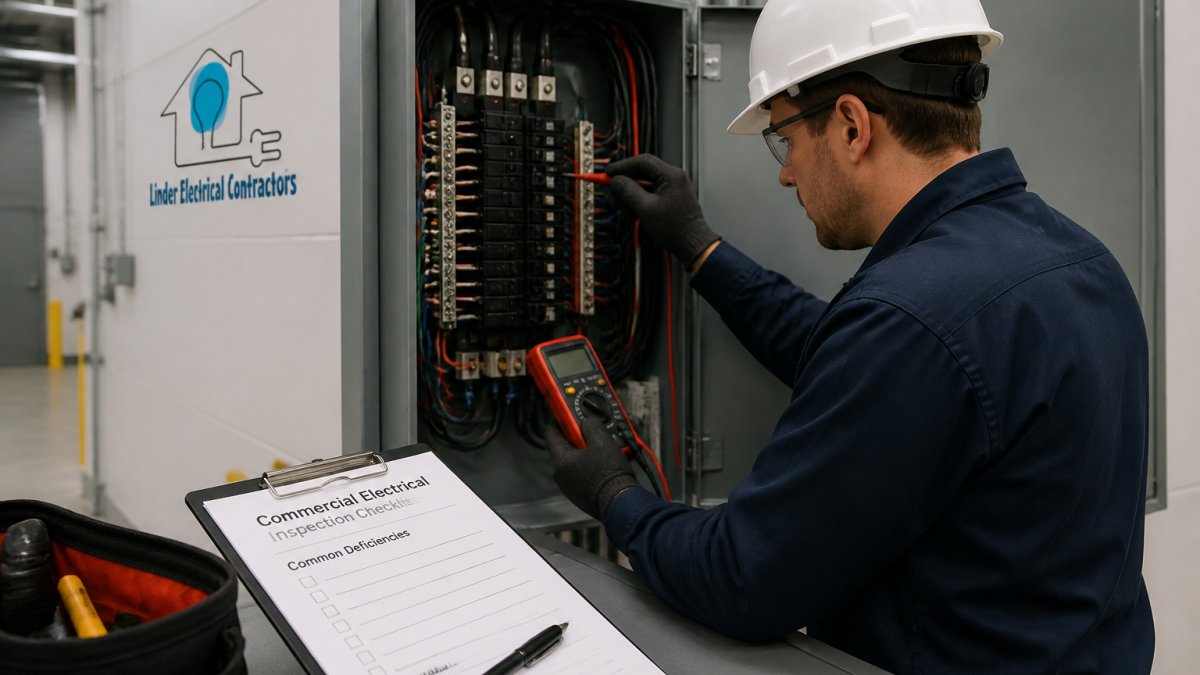
Common deficiencies include inadequate grounding and bonding, which increases shock and fire risk. Missing or improper overcurrent protection allows dangerous currents to flow. Undersized or deteriorated wiring can overheat and cause fires.
Older commercial buildings often have deferred maintenance issues: corroded conduit, brittle insulation, outdated panel designs, and equipment that no longer meets current standards. These buildings may still operate, but they carry elevated risk.
An inspection report documents each deficiency, its location, and the code section it violates. The report becomes your roadmap for corrections. Prioritizing deficiencies by safety impact and cost helps you allocate budget effectively.
Identifying and Correcting Commercial Electrical Code Violations
A code violation is any installation or condition that doesn't meet the requirements of the adopted code edition. Violations range from minor documentation issues to serious safety hazards.
Minor violations might include missing labels on breakers, incorrect wire identification, or incomplete documentation. These are corrected by adding labels, updating records, or submitting missing paperwork.
Serious violations involve actual safety hazards: exposed live conductors, inadequate grounding, overloaded circuits, or improper overcurrent protection. These require physical correction, rerouting cables, upgrading panels, adding protection devices, or replacing equipment.
The correction process starts with understanding what the code requires and why. Many violations exist because the original installation didn't account for code changes, or because the building's use changed without corresponding electrical upgrades.
Compliance for Existing Buildings, Renovations, and Change of Use
Existing buildings present unique compliance challenges because they may have been built under older code editions, and code requirements have evolved significantly over time.
When a renovation occurs, the scope of work being done must comply with the current adopted code.
A change of use, converting office space to a data center, or a warehouse to a manufacturing facility, may trigger code compliance requirements.
This is where understanding your jurisdiction's rules matters. Some jurisdictions require full code compliance when a building changes use. Others allow a phased approach.
For property managers, the practical strategy is to plan electrical upgrades as part of broader capital improvement cycles.
We manage this complexity for property managers and building owners.
| Compliance Task | Responsibility | Typical Frequency |
|---|---|---|
| Load calculations | Electrical contractor/engineer | Before major upgrades |
| Permit applications | Electrical contractor | Before any new work |
| Inspections | Authority having jurisdiction | During and after work |
| Deficiency correction | Building owner/contractor | As violations are identified |
| Documentation | Building owner | Ongoing record-keeping |
Frequently Asked Questions
What is the National Electrical Code and why does it matter for commercial electrical code compliance?
The National Electrical Code (NEC), published by the National Fire Protection Association (NFPA), is the primary standard governing electrical installation in commercial buildings across the country. Updated every three years, the NEC establishes minimum safety requirements for wiring methods, overcurrent protection, grounding, and electrical equipment. Local authorities adopt specific NEC editions and may add amendments. Compliance ensures fire safety, shock protection, and operational reliability. Building owners and facility managers must follow the edition adopted by their jurisdiction, which varies by location and can affect design, installation, and maintenance decisions.
When does commercial electrical work require a permit and inspection?
Most commercial electrical work, including new installations, upgrades, panel replacements, and significant repairs, requires a permit and inspection before work begins and after completion. The specific scope triggering permit requirements varies by local jurisdiction and building code adoption. Generally, work affecting the main electrical service, branch circuits, grounding systems, or equipment over a certain capacity needs permitting. The authority having jurisdiction (AHJ) in your location, such as the local building or electrical inspector, determines exact thresholds. Unpermitted work creates liability, complicates property sales, and may void insurance coverage. Always verify requirements with your local code enforcement office before starting.
What are common commercial electrical code violations and how do you fix them?
Common violations include inadequate overcurrent protection, improper grounding or bonding, undersized conductors, incorrect wiring methods for the environment, missing or damaged conduit, improper outlet spacing, and non-compliant electrical panels or equipment. Others include failure to ground metal equipment, improper use of wire gauges (such as 14-gauge wire in high-demand circuits), and missing safety disconnects. Corrections require a licensed electrical contractor to assess the deficiency, design a compliant solution, obtain permits if required, perform the work, and pass inspection. Documentation of corrective action is essential for audit readiness and liability protection.
How often should a commercial building's electrical system be inspected?
Inspection frequency depends on occupancy type, system age, usage intensity, and local code requirements. Most jurisdictions require initial inspection after installation or significant upgrades, then periodic inspections at intervals ranging from one to five years for active commercial use. High-risk occupancies (hospitals, data centers, manufacturing) often require more frequent inspections. Facility managers should also conduct annual visual walkthroughs to identify obvious hazards like loose connections, overheating, or corrosion. When renovation or change of use occurs, a full electrical inspection is typically mandatory. Check with your local authority having jurisdiction for your specific occupancy and inspection schedule requirements.
How do you calculate electrical load for a commercial building?
Commercial electrical load calculation determines the total power demand to size the electrical service, panels, and branch circuits correctly. The process involves identifying all connected equipment and lighting, applying demand factors per NEC Article 220, and summing the results. Demand factors account for the fact that not all equipment runs simultaneously. Calculations must include general lighting, HVAC, motors, kitchen equipment, and any specialized loads. The result determines minimum service size and panel rating. This calculation is critical during design, upgrades, or when adding significant new equipment. A licensed electrical contractor or engineer must perform load calculations to ensure compliance and avoid overloading the system.
What should be on a commercial electrical inspection checklist?
A comprehensive checklist includes visual inspection of the main electrical panel (condition, labeling, overcurrent devices), branch circuit wiring and connections, grounding and bonding systems, outlet and switch condition and spacing, conduit and cable routing, equipment clearances, emergency disconnects, backup power systems, and fire-rated separation. Inspectors verify that all components meet the adopted NEC edition, check for signs of overheating or damage, confirm proper labeling, and test safety devices. Documentation of findings, deficiencies, and corrective actions is essential. A licensed inspector or electrical contractor should perform formal inspections to ensure thoroughness and compliance with local authority requirements.
Does electrical code compliance change when a building is renovated or changes occupancy?
Yes. When a building undergoes renovation or changes occupancy type, the electrical system must comply with the current adopted code edition and may require upgrades to meet new demand, safety, or operational standards. A change of use, such as converting office space to a restaurant or data center, typically triggers a full electrical inspection and may require new or upgraded service, panels, and circuits to handle different load profiles and safety requirements. Existing buildings are generally allowed to maintain older compliant systems, but any new work must meet current code. Consult your local authority having jurisdiction to determine what upgrades are required before occupancy changes or major renovations begin.
Electrical code compliance isn't just a regulatory checkbox, it's the foundation of safe, reliable electrical infrastructure. When you work with a contractor who understands code requirements, manages permits, and coordinates inspections, you reduce risk and avoid costly rework. Linder Electrical Contractors brings that expertise to every commercial project, ensuring your building meets current code standards and operates safely.