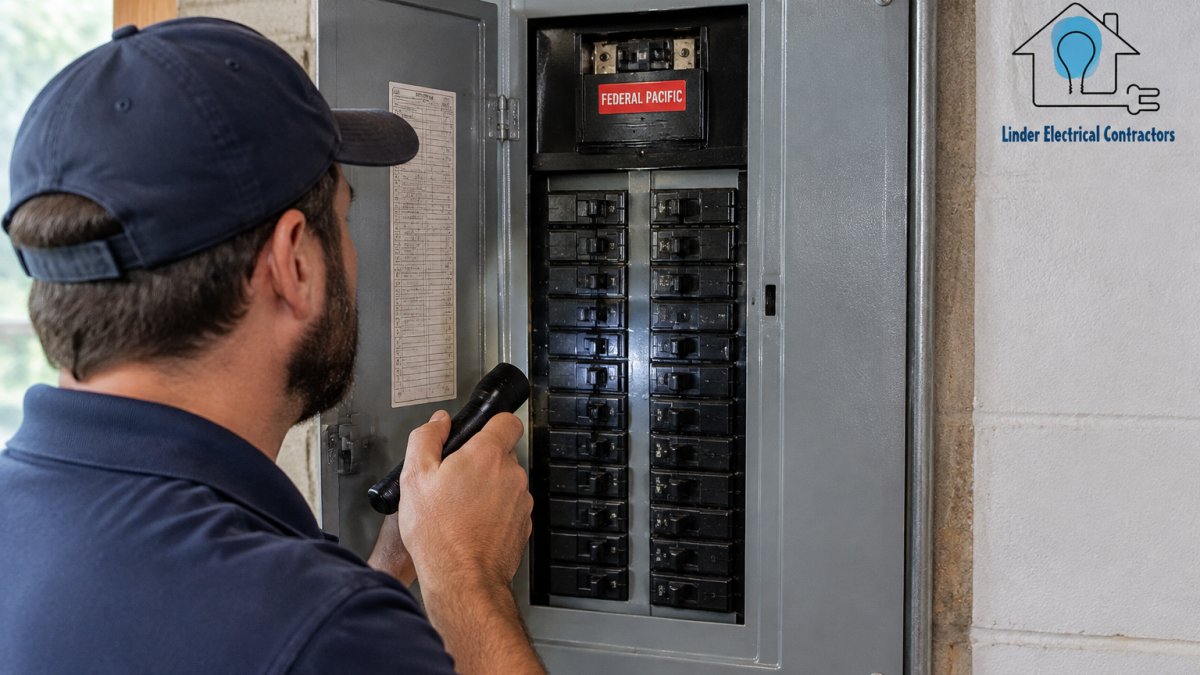
 How-to
How to Identify a Federal Pacific Panel in Your Home
Last Updated: November 5, 2026
Quick Summary
To identify a Federal Pacific panel, open the panel door and read the interior label for names like Federal Pacific Electric, FPE, Stab-Lok, Federal NOARK, or Federal Pioneer. If the label is missing, look for thin breaker handles with a red or orange label strip and breakers that push onto a flat slotted bus bar.
- Never remove the dead front cover to identify a panel; reading the door label is enough.
- Stab-Lok breakers connect to the bus bar with a friction fit, not a bolted connection.
- A date code between the mid-1950s and early 1980s is consistent with Federal Pacific's peak years.
- Red and orange breaker strips are not exclusive to Federal Pacific and can appear on lookalike panels.
- If labels are illegible and breakers are ambiguous, stop and book a licensed electrician's inspection.
Table of Contents
- Start With the Panel Door and Interior Label
- How to Identify Stab-Lok Breakers by Their Shape and Labels
- Federal Pacific Breakers and the Bus Bar Design That Gives Them Away
- Model, Serial, and Manufacturing Location Clues
- Are Federal Pacific Panels Safe? What the Failure Records Show
- The Federal Pacific Electrical Panel Recall Question, Answered
- When Labels Are Ambiguous: A Visual Decision Path
- Book a Panel Inspection Before You Buy or Renovate
- Frequently Asked Questions
Start With the Panel Door and Interior Label
Learning how to identify a Federal Pacific panel starts with one simple move: open the panel door and read the label. It is the fastest, safest way to confirm what you have, no need to remove the cover or touch any wiring.
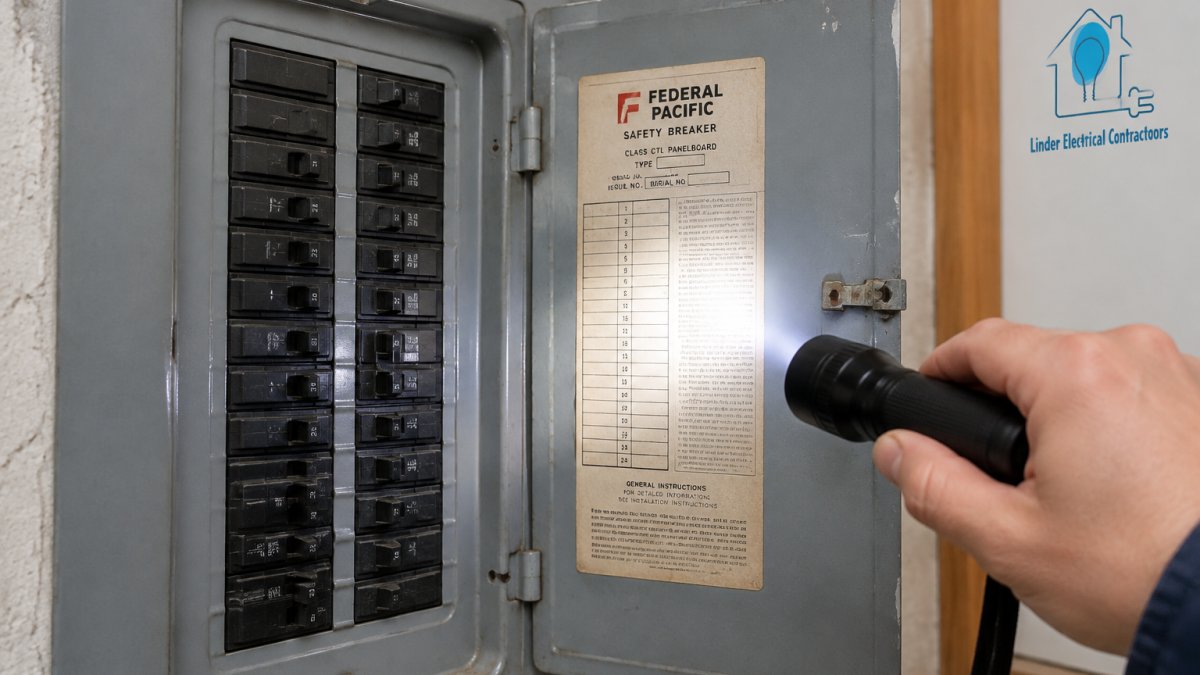
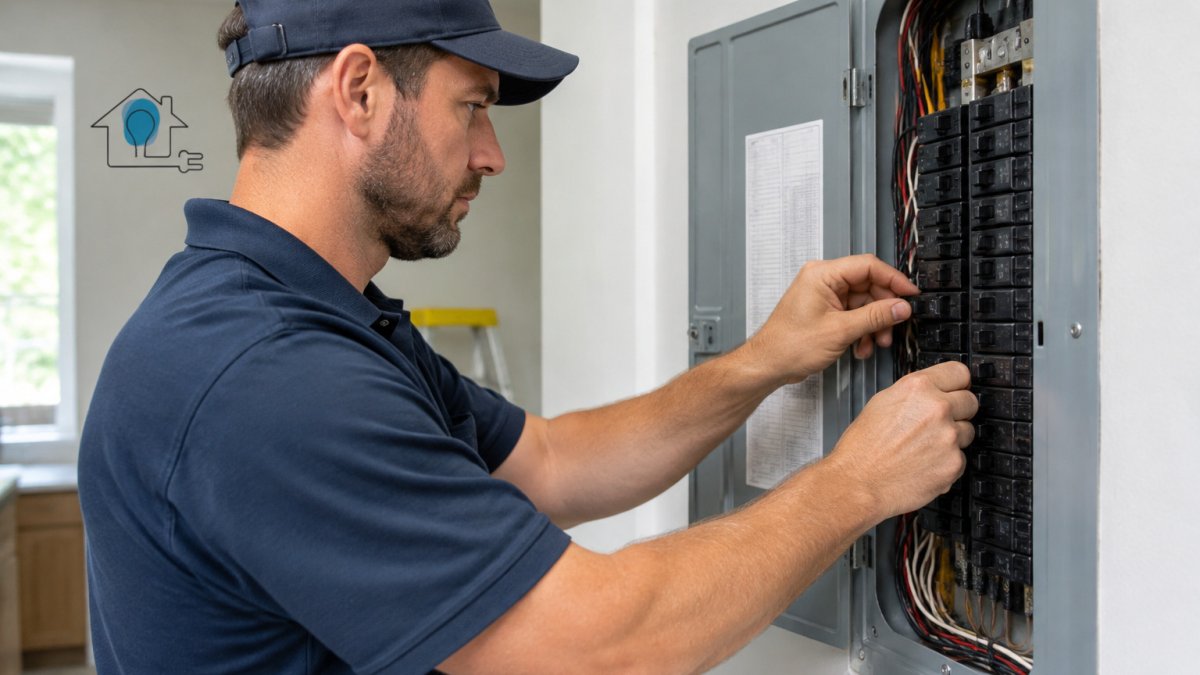
- Open the panel door. Do not remove the dead front cover.
- Look for a sticker or stamped label on the inside of the door.
- Check the top or side of the interior for a brand name.
- Photograph the label with your phone for reference.
Where the Manufacturer Marking Usually Sits
The marking is almost always on the inside of the panel door. It may also appear on a sticker near the top of the enclosure or along the side wall.
Look for a paper label, a metal nameplate, or text printed directly on the cover. The name is often small and faded on older panels.
- The inside face of the door
- The upper left or right corner of the enclosure
- A strip label running along the breaker row
If the label is gone or painted over, move on to the breaker clues below.
Product Names to Look For: FPE, Stab-Lok, Federal NOARK, Federal Pioneer
Federal Pacific Electric sold panels under several names over the decades.
You may also see Federal NOARK or Federal Pioneer on panels made after the company changed hands or sold into other markets.
- Federal Pacific Electric
- FPE
- Stab-Lok
Any one of these on the label is a strong signal worth flagging.
Here are the product names that signal a Federal Pacific panel when they appear on the label.
| Name on label | Notes |
|---|---|
| Federal Pacific Electric | Most common name, shortened to FPE |
| FPE | Abbreviation for Federal Pacific Electric |
| Stab-Lok | Main breaker line |
| Federal NOARK | Seen on panels made after the company changed hands |
| Federal Pioneer | Seen on panels sold into other markets |
How to Identify Stab-Lok Breakers by Their Shape and Labels
If the label is missing, the breakers themselves tell the story. Learning how to identify Stab-Lok breakers comes down to shape, color, and the label strip.
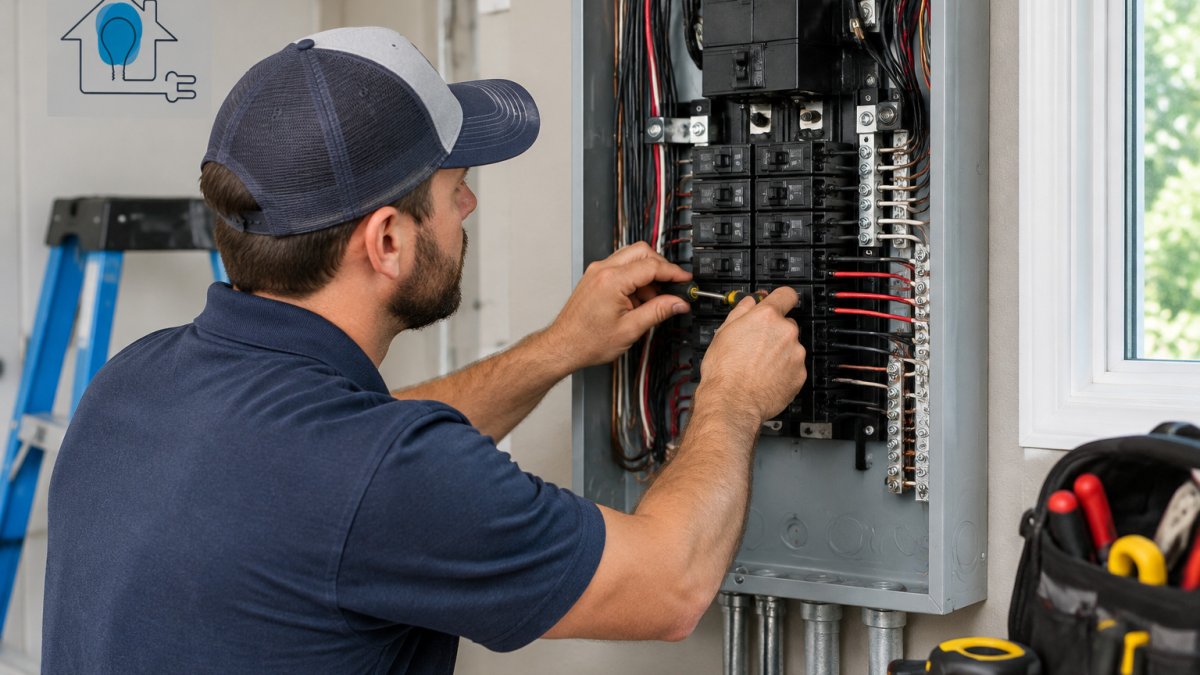
Federal Pacific breakers have a distinct look: thin handles that sit close to the panel face, dark plastic, and a colored strip across the front.
- Thin, narrow breaker handles that sit nearly flush
- A red or orange label strip across the breaker face
- Breakers that feel loose or sit unevenly in the panel
Breaker Handle, Color, and Label Strip Clues
The breaker handle on a Stab-Lok unit is slimmer than most modern breakers, moves with less resistance, and can feel loose.
Color matters too. Many Stab-Lok breakers carry a red label or orange label strip.
If several breakers share the same thin handle and colored strip, you likely have a matching set from the same maker.
Federal Pacific Breakers and the Bus Bar Design That Gives Them Away
That friction connection is central to the safety concerns. The breaker snaps onto the bus connector and holds by spring tension alone. Over time, that grip can weaken.
- A flat metal bus bar with slots where breakers clip in
- Breakers that push on rather than bolt down
- Thin metal contacts on the back of each breaker
Do not poke at the bus bar or remove breakers to inspect it. Visual inspection from a safe distance is enough; anything more is a job for a licensed electrician.
Model, Serial, and Manufacturing Location Clues
When the brand name is worn, painted over, or missing, model and serial information becomes the next best evidence. These codes do not replace a label, but they can narrow the manufacturer and era enough to justify a professional inspection.
Where the Codes Sit
- On the same interior door label as the brand name, often in a small box or along the bottom edge
- On a separate metal nameplate riveted to the enclosure
- Stamped directly into the metal on the inside of the cover or the side wall
Photograph each location before you try to read it. Faded ink and low light are the two most common reasons people misread a code.
Reading a Model Number
Model numbers on older panels are usually short alphanumeric strings, often a letter prefix followed by digits encoding the panel series, bus rating, and number of spaces.
Watch out: do not confuse the model number with the short catalog number printed on an individual breaker. The breaker number identifies the breaker, not the panel, and mixing them up sends the identification in the wrong direction.
Reading a Serial Number and Date Code
Serial numbers are typically longer than model numbers and may include a date code; on many older panels the first characters encode the year or quarter of manufacture.
If the serial is stamped rather than printed, tilt your phone light across the metal at a low angle. Stamped characters often read more clearly in a photograph than they do by eye.
Manufacturing Location as a Supporting Clue
Older nameplates sometimes list a manufacturing city, state, or plant code, which can support identification when the brand name is gone. Treat it as one piece of evidence among several: a plant code alone does not confirm the manufacturer, and a missing location line does not rule out Federal Pacific equipment.
When the Label Is Repainted or Partly Missing
A repainted cover is one of the most common reasons a panel becomes hard to identify, since paint fills stamped characters and covers paper labels. If the cover looks repainted, check the enclosure for a second nameplate or stamped marking. If both are gone, rely on the breaker row and bus connection style, and treat the panel as unidentified until an electrician confirms it.
What to Hand to an Electrician
- A clear photo of every label, nameplate, and stamped marking
- The model number exactly as printed, including any prefix letters
- The serial number and any date code
A licensed electrician can use those details to help confirm the panel make and model.
Are Federal Pacific Panels Safe? What the Failure Records Show
Federal Pacific panels have a documented history of breaker failure, and the core problem is a breaker that does not trip.
A breaker's whole job is overcurrent protection. When a circuit pulls too much current, the breaker should trip and cut the power.
That means a circuit can overheat without the breaker ever shutting it off, creating a real fire risk and a serious electrical hazard.
- Breakers that fail to trip under overload
- Loose connections at the bus that cause overheating
- Tripped breakers that can be forced back on
If you have one, have it checked. If you are in an older home, it is also worth reading about common electrical hazards in older houses so you know what else to watch for. Many owners then want to know what a panel replacement costs before they decide, and it helps to review the signs you need an electrical panel upgrade so nothing gets missed.
The Federal Pacific Electrical Panel Recall Question, Answered
- No recall notice does not mean the panel is safe
- A panel can stay in a home for decades without being flagged
- The only reliable answer comes from an inspection
Do not rely on a quick web search to clear your panel. Get eyes on it.
When Labels Are Ambiguous: A Visual Decision Path
Most identification guides stop at "look for the label." In practice, the hard cases matter most: a repainted panel, a swapped cover, a label faded to a blank rectangle, or a breaker set that mixes brands after decades of service work.
- Read the door label and any interior nameplate first. If it says Federal Pacific Electric, FPE, Stab-Lok, Federal NOARK, or Federal Pioneer, treat the panel as Federal Pacific equipment and move to professional verification. Do not remove the dead front to confirm.
- Check for a repainted or replaced cover. A cover that does not match the enclosure's age, paint, or screw pattern is a warning that the original label may be gone. Check hinge wear, screw heads, and whether the cover sits flush; a mismatched cover means its label cannot be trusted as the panel's original identification.
- Inspect the breaker row from the open door only. Note handle shape, handle color, label strip color, and whether breakers sit evenly. Stab-Lok breakers typically have thin handles that sit close to the face and often carry a red or orange strip. If most breakers share that look, the panel is a strong suspect even without a readable label.
- Look for mixed breaker brands. Two or three different breaker brands in the same row suggest past replacement work. Mixed brands neither clear nor confirm a Federal Pacific panel; treat it as unidentified until a licensed electrician checks bus and breaker compatibility.
- Check the bus connection style without touching it. From a safe distance, note whether breakers appear to push onto a flat slotted bus or bolt down. Push-on friction connections are consistent with Stab-Lok design, but they are a clue, not proof.
- Look for model and serial remnants. Even a partial model number, a plant code, or a testing-lab mark can support identification. Photograph whatever is legible and hand it to an electrician.
- If nothing is legible and the breakers are ambiguous, stop. Do not remove breakers, do not probe the bus, and do not guess. Book an inspection.
Watch out: a clean, modern-looking cover does not mean the panel behind it is modern. Judge the enclosure, the breaker row, and the label together rather than trusting any single clue.
Lookalike Panels and Why Color Alone Fails
Red and orange breaker strips are not exclusive to Federal Pacific. Several manufacturers used colored strips over the decades, and aftermarket breakers can mimic the look. A colored strip is a prompt to look closer, not a verdict.
A common field pattern is a panel with a faded label, one or two original Stab-Lok breakers, and several later replacements of a different brand. The panel is still a Federal Pacific enclosure, and the mixed breakers add a second concern: whether the replacements are listed for that bus. Only a licensed electrician can verify compatibility.
What Counts as Inconclusive
Identification is inconclusive when the label is unreadable, the cover appears replaced, and the breaker row is mixed or unfamiliar. That is a valid result: the panel needs professional verification before anyone treats it as safe or unsafe.
The Limits of Visual Identification
Labels, breaker colors, and handle shapes are clues about what equipment is installed, not proof of its condition, and they do not tell you whether a specific breaker will trip under overload. Identification answers "what is this panel?" A safety assessment answers "is it working correctly?" Keep the two separate and let a qualified electrician handle the second question.
Book a Panel Inspection Before You Buy or Renovate
If you have a Federal Pacific panel, or you are not sure, do not wait for a problem to show up. A panel inspection is the only way to know what you are dealing with.
At Linder Electrical Contractors, we are licensed and insured, and we handle the whole job, including permits and inspections. If you are buying a home or planning a renovation, you can schedule a residential electrical safety inspection and get a clear answer. Before we arrive, it helps to know how to prepare your home for an electrical inspection.
Get a free estimate from Linder Electrical Contractors and find out whether your panel is safe.
Frequently Asked Questions
How do I tell if I have a Federal Pacific electrical panel?
Open the panel door and read the label on the inside of the cover. Look for the words Federal Pacific Electric, FPE, or Stab-Lok. Then check the breaker handles: Stab-Lok breakers are usually thin, with a red or orange label strip and a distinct handle shape. If the label is missing or painted over, the bus bar design and breaker fit are the next clues. A licensed electrician can confirm the make and model before you make any decisions.
Can I sell a house with a Federal Pacific panel?
You can list a home with a Federal Pacific panel, but expect the buyer's home inspector to flag it. Many buyers ask for a replacement or a credit during negotiations, and some lenders and insurers want documentation before closing. Getting a written evaluation from a licensed electrician before you list gives you a clear picture of the panel's condition and helps you price the home realistically.
Do all Federal Pacific panels need to be replaced?
Not every Federal Pacific panel is automatically a replacement job, but the safety concerns around Stab-Lok breakers mean most electricians recommend planning for one. The decision depends on the specific model, the condition of the bus bar, and whether the breakers trip correctly under test. A qualified electrician should verify the panel in person rather than relying on a photo or a label alone.
What should I do if I find a Federal Pacific panel?
Do not open the panel cover or touch the breakers beyond normal use. Note the label wording and take photos with the door open only. Then call a licensed electrician for an inspection. They can check for overheating, test breaker operation, and tell you whether a replacement or a repair is the right next step. Get a free written estimate so you know what the work involves before you commit.